You don’t really notice how messy your tech stack is until something breaks on launch day.
A client upgrades and doesn’t get access.
An affiliate swears a sale is missing.
Your “subscription” report shows one number, Stripe shows another, and your spreadsheet has a third.
One tool builds pages.
Another sort of manages subscriptions.
A third tracks affiliates.
Dunning is a separate plugin.
Reporting is Google Sheets and anxiety.
At some point you realize you’re not running a business anymore. You’re babysitting tools.
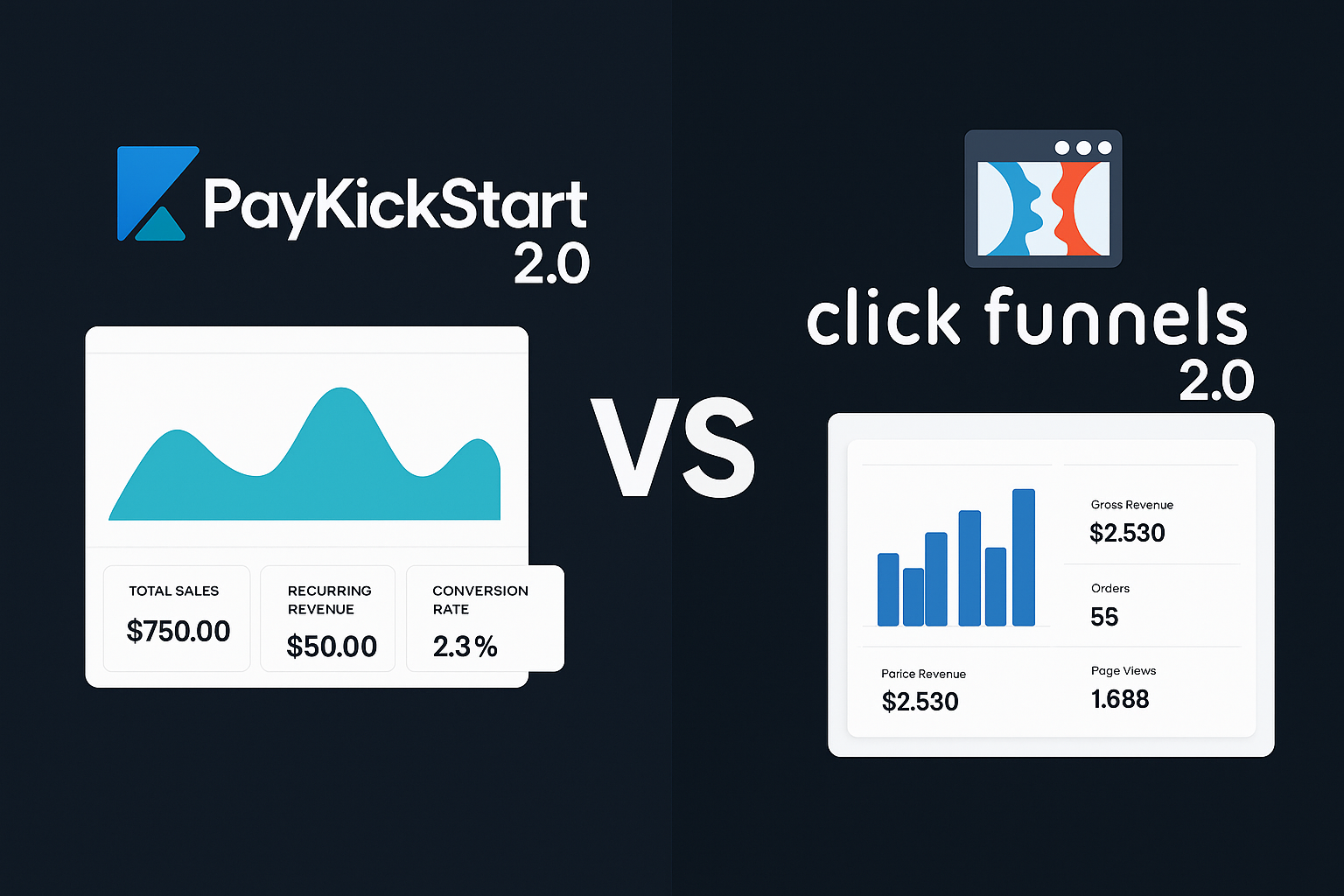
That’s what pushes most people toward platforms like PayKickStart 2.0 and ClickFunnels 2.0. The promise is simple:
“Let one serious platform handle the money side, so you can focus on offers, content, and customers.”
In this review, I’m putting these two head to head. I’ll walk through how they stack up on billing, checkouts, funnels, affiliates, analytics, and pricing, then I’ll tell you where I’d put my money first.
Short spoiler: both are strong, but for most serious digital businesses that depend on recurring revenue, PayKickStart 2.0 is the smarter core.
👉 Click Here to get PayKickStart 2.0 at 65% Discount
How I Looked At Both Platforms
Instead of just listing features, I focused on five things that actually move the needle:
- How clean the billing and subscription engine is
- How much extra revenue you can squeeze out of the same traffic
- How it handles affiliates and payouts
- How good the reporting is for real decisions
- What you actually get for the price
With that lens, the differences between PayKickStart 2.0 and ClickFunnels 2.0 become very clear.
The Core Difference In Plain English
Here’s the simplest way to think about it:
- PayKickStart 2.0 is a revenue engine and subscription hub. It’s built for payments, recurring billing, dunning, churn reduction, affiliate management, and detailed revenue analytics. You plug it into whatever front end you want.
- ClickFunnels 2.0 is an all-in-one funnel and marketing platform. It lets you build funnels, websites, courses, memberships, and run email automation and basic CRM inside one interface.
Those are two different philosophies.
If you want a serious billing brain that can sit behind any tech stack, PayKickStart makes more sense.
If you want a “one box” marketing machine that does a bit of everything, ClickFunnels is the obvious candidate.
Let’s dig in.
What Stood Out To Me About PayKickStart 2.0
PayKickStart feels like it was built by people who have actually been beaten up by subscriptions, chargebacks, and messy affiliate payouts.
Payments, Methods, and Billing Models
PayKickStart 2.0 is very comfortable with complexity:
- Cards, wallets, bank transfers and PayPal
- Support for multiple gateways
- Global payments in 100+ countries and 135+ currencies
- One-time, recurring, usage-based, freemium, trials, payment plans and add-ons out of the box
If your business has moved past “one $997 product,” you notice this quickly. You can model almost any pricing strategy you’d dream up for SaaS, memberships, bundles, or multi-tiered offers.
Checkouts That Actually Sell
A lot of tools treat checkout like a boring form. PayKickStart treats it like the last step of marketing.
You get:
- 40+ checkout templates
- Embedded forms and popup checkouts you can drop into any page
- One-click upsells
- Order bumps
- Exit-intent prompts
- Cart recovery sequences that bring people back after they abandon
You don’t just collect money. You push up average order value without needing a dev team, and you rescue sales that would have silently died.
Retention, Dunning, and Churn
This is where PayKickStart really separates itself. Out of the box you can:
- Send pre-dunning emails when cards are about to expire
- Set smart retry rules for failed payments
- Let customers update their own payment methods in a self-serve portal
- Trigger cancellation flows that offer alternatives or discounts before someone churns
All of that shows up in metrics like MRR, churn rate, and recovered revenue, which PayKickStart tracks for you.
If recurring revenue is the heart of your business, this matters more than any extra page template.
Affiliate Management That Feels Built-In, Not Bolted-On
PayKickStart’s affiliate tools don’t feel like an afterthought. You get:
- An affiliate center with first- and second-tier commissions
- Flexible commission rules and performance tiers
- Automated payouts through the PayKickStart wallet
- A marketplace where affiliates can discover offers and see performance data
The big win is that your billing data and affiliate data live in the same brain. No more arguing with two different tools about who earned what.
Reporting: Real Business Numbers
On the reporting side, PayKickStart gives you:
- Revenue and transaction dashboards
- MRR, ARR, churn, recovered revenue
- Product, funnel, and affiliate performance
Tools like Capterra and SoftwareAdvice consistently highlight PayKickStart as “more than just a shopping cart,” and that’s exactly how it feels.
Pricing: Not As Scary As It Looks
Public pricing pages and directories put PayKickStart in the $99–$299 per month range across Starter, Growth and Scale tiers, depending on volume and features.
It is not the cheapest thing you can buy. But if you compare it against:
- A separate cart
- A separate subscription tool
- A separate affiliate platform
- A separate dunning service
it actually replaces a lot. And with a strong promotional discount, the value looks even better.
👉 Click Here to get PayKickStart 2.0 at 65% Discount
If I was building a business where recurring revenue is non-negotiable, this is where I’d start.
What Stood Out To Me About ClickFunnels 2.0
ClickFunnels plays a different game. It’s less “billing brain” and more “marketing headquarters.”
Funnels, Pages, and Sites
ClickFunnels 2.0 is built for non-developers who want to ship funnels fast:
- Drag-and-drop funnel builder
- Templates for opt-in funnels, sales funnels, webinar funnels, application funnels, and more
- Full website and blog builder baked in
If you have never built a funnel before, it can save you months of flailing around in WordPress.
Courses, Memberships, and Email
The 2.0 release pushed ClickFunnels more into the “all-in-one” direction:
- Course and membership hosting
- Customer center to manage products and access
- Built-in email broadcasts, workflows, and basic CRM capabilities
So in theory, you can:
- Drive traffic to a funnel
- Close the sale
- Deliver the course
- Nurture the customer
All inside one login.
Where ClickFunnels Feels Weaker
ClickFunnels 2.0 has payment and subscription features, but they are more “good enough for many” than “deep subscription engine.” Third-party reviews consistently frame it as a strong sales funnel tool with added course and membership features, not a specialist billing platform.
You can absolutely run recurring offers with it, but you don’t get the same level of:
- Dunning control
- Recovery workflows
- Retention analytics
that PayKickStart focuses on.
Pricing And The 3-Months-For-$99 Deal
Recent pricing breakdowns show ClickFunnels 2.0 with plans around:
- Launch: $97 per month
- Scale: $197 per month
- Optimize: $297 per month
Every plan includes unlimited funnels and pages, which is appealing if you run a lot of campaigns.
The standout right now is the 3 months for $99 promo. Independent breakdowns confirm it gives new users full access to the Scale plan (normally $197 per month) for three months for a flat $99, roughly an 83% discount over that period.
If you’ve wanted to properly test ClickFunnels 2.0 without committing to full price, it is a very low-risk way to do that.
👉 Click Here to Get ClickFunnels 3 Months for $99
How They Feel Side By Side In Real-World Scenarios
Scenario 1: You Run SaaS, Memberships, or Heavy Subscriptions
If most of your revenue is recurring, you live and die by:
- How many people stick
- How fast you recover failed payments
- How cleanly you can analyze churn and lifetime value
In that world, PayKickStart 2.0 wins by a mile.
You still need pages and some kind of funnel, yes. But the bottleneck is usually not “I need another page template.” It is “I need rebills to fire correctly and customers to stay.”
The dunning tools, recovery flows, and subscription analytics inside PayKickStart are built exactly for that.
Scenario 2: You’re A Course Creator or Coach Starting From Scratch
If you do not yet have a funnel builder, and you want:
- Landing pages
- Sales funnels
- Course hosting
- Basic email
all set up quickly, then ClickFunnels 2.0 is very appealing. You’re buying speed and simplicity. You can be live with a proper funnel and product delivery without hiring a dev or gluing five tools together.
Later, if your subscription and billing needs get more advanced, you can always add PayKickStart behind the scenes.
Scenario 3: You’re An Agency Or Funnel Consultant
If most of your work is building funnels for clients, your buyers probably already understand ClickFunnels. There is a huge ecosystem of tutorials, templates, and communities around it, which makes client handover easier.
But if your agency specializes in recurring revenue optimization and high-volume billing, PayKickStart gives you something else to sell:
- Better checkout performance
- Better dunning and retention
- Better affiliate visibility
You can plug it into whatever front-end system your client has and be the “money team” on top.
Scenario 4: You Just Have One Flagship Offer
If you sell one or two products and mainly want a single clean funnel, you can succeed with either platform.
The real question is:
- Do you care more about the front end (pages, funnel flow, speed to launch)?
- Or the back end (billing, retention, affiliate payouts, long-term revenue)?
If I had to pick one to bet on for a single core offer, I’d still lean PayKickStart 2.0, because even on one product, improving dunning and AOV usually beats having another page template.
👉 Click Here to get PayKickStart 2.0 at 65% Discount
What Surprised Me Most
A few things stood out as I compared both.
- ClickFunnels 2.0 really has grown into a true “all-in-one” system. The course and membership features are no longer tacked on. For a lot of creators, that alone will justify the subscription.
- PayKickStart 2.0 still flies under the radar for many people. Yet independent reviews and comparison sites rate it very highly as a subscription billing and affiliate management solution, not just a cart.
- The more complex your business gets, the more PayKickStart’s “unsexy” features matter. Stuff like fraud rules, chargeback handling, and advanced reporting do not make slick webinar slides, but they keep your margins alive.
- The ClickFunnels 3-months-for-$99 deal is genuinely strong. If you have been on the fence, it is hard to argue with three months of a premium plan at that kind of discount.
So… Which One Would I Choose First?
If you forced me to pick one to build a long-term, serious digital business around, my choice would be:
👉 PayKickStart 2.0 as the core revenue engine.
Here is why:
- It treats payments, subscriptions, and affiliates as the main event, not a side feature.
- It plugs into any front end, so I’m not locked into one funnel builder forever.
- It gives me the kind of metrics I care about once a business moves past its first launch.
I would happily use ClickFunnels 2.0 as a front-end funnel builder when it fits the project. In fact, a lot of larger teams end up using ClickFunnels on the front and PayKickStart on the back for serious billing and affiliate operations.
But if we’re talking about where I’d put my first dollar as a foundation, PayKickStart wins.
If you’re at the point where:
- Subscriptions matter
- Affiliates matter
- Churn hurts
- And you’re tired of spreadsheets and half-baked dunning
then I’d strongly suggest starting with PayKickStart and letting it be your financial command center.
👉 Click Here to get PayKickStart 2.0 at 65% Discount
If you also want a visual funnel builder and course platform in one, or you’re a coach or creator starting from zero, it is still worth grabbing the ClickFunnels promo and seeing how it feels in your hands.
👉 Click Here to Get ClickFunnels 3 Months for $99
In short:
- ClickFunnels 2.0 is a great front stage.
- PayKickStart 2.0 is a great back stage.
But when every dollar of recurring revenue counts, I’d rather start by getting the back stage right.